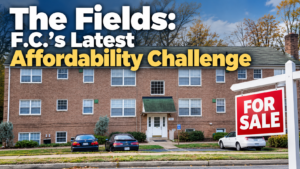
This time it took almost six hours, but at the end of the day (or the beginning of a new one), in the wee hours of Tuesday, the Falls Church City Council achieved a surprising and resounding 6-1 vote for a first reading, preliminary approval of a complex plan to bring redevelopment and new affordable housing to the 4.5 acres in the center of the Little City known as the Virginia Village.
The existing project is a collection of 20 four-plex apartment buildings that house 80 in outdated, 1941-constructed homes. As Mayor Letty Hardi pointed out in her summarizing remarks early Tuesday (cited in the editorial, elsewhere in this issue), the current effort has already been five years in the making, and the goal of winning final approval by next March is still ambitious, but a lot closer to reality now than when Monday’s meeting began and a plethora of citizens showed up to urge delay and changes to the process.
That the final vote was 6-1 surprised everyone, but should not be taken as an indicator that the controversy surrounding the initiative will go away. But it may contribute to keeping the plan on schedule. The U.S. congressional vote this week to fund its largest commitment to affordable housing in a generation and the victories of pro-housing advocates in urban centers across the U.S. are signalling what Falls Church has found this week: the needs of affordable housing are real and honest politicians are reacting to that fact.
Councilman David Snyder wound up joining the majority on the Council in memory of his steadfast advocacy for affordable housing in 2011, the last time a serious plan was before the City Council in the form of the Wilden Senior Living project that despite the yeoman efforts of former Councilman Steve Rogers and Carol Jackson of the City’s Housing Corporation, failed by a single vote.
That project was named for the Rev. Robert Wilden, who was a strong affordable housing advocate in the CIty. When the final vote was indicated, not even taken officially, the Housing Corporation disbanded, Jackson resigned, and nothing happened on that front until this most recent effort developed under Hardi’s leadership.
Ex-Mayor Nader Baroukh, who led the effort to kill the 2011 project, was in the audience Monday when the 6-1 vote was taken, still calling for delay and the same approach that killed the Wilden Project.
At the end of the meeting this time, however, only Council member Erin Flynn voted against the first reading. Though participating remotely, Council members Justine Underhill and Marybeth Connelly joined the six vote majority voting yes, along with new Council member Arthur Agin.
Agin did initiate the vote to limit the heights in the new project to six stories. It passed 7-0. The vote was on the fifth iteration of the plan developed over five years.
The City now owns nine of the 20 fourplexes, and plans to issue a request for proposals and zoning changes aimed at defining what the City wants for the 11 buildings it does not own, in addition to the ones it does.
The second reading of the comprehensive ordinance is now set for July 27.
In a pivotal move to aggressively expand the city’s affordable housing inventory, the City of Falls Church City Council voted 6-1 on June 22 to advance the Virginia Village redevelopment plan, approving a Request for Proposals (RFP) to solicit developers for the 4.5-acre site.
The monumental 6-1 decision officially greenlights the city’s Economic Development Authority (EDA) to issue the comprehensive RFP to prospective housing partners. The vote marks the culmination of months of intense deliberation, zoning reviews, and heated community visioning sessions regarding the aging, 1940s-era quadplexes that currently make up the Virginia Village neighborhood.
Located behind the former Bowl America Falls Church, the Virginia Village site is one of the most critical municipal housing initiatives in recent memory. Over the last decade, the city has strategically land-banked several of the properties—acquiring nine of the twenty quadplexes—to preserve existing affordable units and preempt private, high-priced luxury redevelopment.
However, the eighty-year-old buildings are now facing cost-prohibitive maintenance issues. With an ambitious goal under the city’s updated Affordable Living Policy to increase the ratio of affordable housing stock from 3 percent to 6 percent by 2040, city leaders recognized the necessity of leveraging third-party developers.
The approved RFP invites prospective development teams to pitch creative solutions based on three distinct development scenarios, or hybrids of them:
Rehabilitation with Expansion: Modernizing the existing footprint of the city-owned properties, potentially adding an extra floor.
Low-Intensity Redevelopment: Demolishing the current structures and rebuilding up to four stories.
Larger Infill Redevelopment: A comprehensive teardown that replaces the current buildings with multi-story structures reaching up to six or seven stories.