The just-concluded Virginia general assembly session in Richmond, now with a Democratic Party “trifecta” in charge, turned out better than expected due to the fact that revenues to the state did not nosedive, due to federal program cuts, as many had feared.
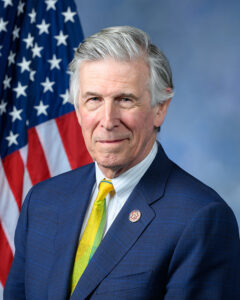
Falls Church’s state delegate Marcus Simon laid out the picture to the monthly luncheon of the Falls Church Chamber of Commerce at the Italian Cafe Tuesday.
With Democrats extending their majority in the House of Delegates to 64-36 while holding a slim 21-19 majority in the state senate and taking the governor’s mansion with the election of Abigail Spanberger in November, important civil rights and other fairness legislation passed this session in anticipation of the governor’s signature in the coming days.
Two issues were in the forefront: the April referendum (with voting now underway) to permit a temporary redraw of the state’s 11 U.S. congressional district boundaries – countering the Trump/GOP effort to do likewise in other states – and the still-controversial Tysons casino bill.
Simon told the Chamber lunch gathering that betting institutions are giving passage of the referendum a thumbs up, although by a narrow margin. He said it is expected to be a close vote by the time polls close on April 21. Spanberger has endorsed a “yes” vote, and former U.S. President Barack Obama has been all over the airwaves with a TV statement urging its passage.
The referendum language reads, “Should the Constitution of Virginia be amended to allow the General Assembly to temporarily adopt new congressional districts to restore fairness in the upcoming elections, while ensuring Virginia’s standard redistricting process resumes for all future redistricting after the 2030 census?”
In Falls Church, early voting is open at the Voter Registrar’s office at City Hall, 300 Park Avenue, on weekdays from 8 a.m. to 5 p.m. (7 p.m. on Thursday, April 16) and Saturdays from 9 a.m. to 5 p.m.) until the April 21 general election day.
On the controversial casino issue, Simon said he’s been opposed to it from the beginning, though a version of it passed in Richmond spearheaded by State Sen. Scott Surovell. The final version to pass in a split vote allows for a casino in the Tysons area that would be contingent on an OK from a Fairfax County-wide referendum. It allows for a temporary casino ahead of a referendum vote, which the Fairfax County Board of Supervisors would have to authorize (supervisor opposition is overwhelming so far). It is not known yet how the governor will sign, veto or modify the bill.
The State Senate voted 25-13 and the House of Delegates voted 55-41 to accept the bill, sending it to the governor.. Another important supporter of the bill is State Sen. Dave Marsden. Simon said he opposed it because “it is imposed on a local jurisdiction from Richmond, it is not good policy, nobody here has asked for it, and is not a good fit for Tysons.”
Del. Simon hailed the overall achievements of the legislative session, saying they contributed to “a more stable business environment, workforce gains, housing affordability and investments in regional transportation.” In the last case, state funding for WMATA will be up, but by what exact amount is not yet clear, which will ease burdens on funding from localities.
Simon said among his own achievements this session were the abolition, after all this time, of an anachronistic law defining suicide as a crime, the banning of unserialized ghost guns, the allowance by state courts to hear class action lawsuits, and a provision for uniform default judgments.
Among the most consequential acts of the session were those that placed three referendum items on this November’s ballot, one which would codify the state’s commitment to provide abortion services, one to codify the ability of felons to vote, and one to overturn the divisive Marshall-Newman amendment and allow for same-sex marriages.
On affordable housing, bills passed that grant first-right-of-refusal to jurisdictions where formerly affordable units are put onto the market, and that streamline the affordable housing approval process in jurisdictions where “NIMBY” (not in my back yard) opposition has been able to hold up process.
On health care, bills to limit prescription costs passed, including the formation of a prescription drug affordability board. Measures to improve access to child care passed, provisions to advance paid sick leave, and a $15 per hour minimum wage law was passed to go into effect in 2028.
On the dicey issue of data centers, Simon said that, a whole range of key issues remain. “Northern Virginia is the world’s largest data center hub, and 10s of billions have been invested,” Simon noted. “Demand, costs, land use impacts, proximity to residential areas, environmental and noise impact and tax incentives are all key issues that need to be addressed,” he said.
Overall, he said, the federal DOGE has slowed down, federal dollars to the state have not decreased, the impact of the Iran war is to be determined, and overall the situation is “not horrible.”
The speed and red light camera issue was advanced to allow for “Safety Red Zone” block targeting by localities, and locally, money to help improve a dam at Lake Barcroft was provided, as well as money in response to an initiative by 5th grade students from Falls Church’s Oak Street Elementary to build out outdoor educational spaces there.