


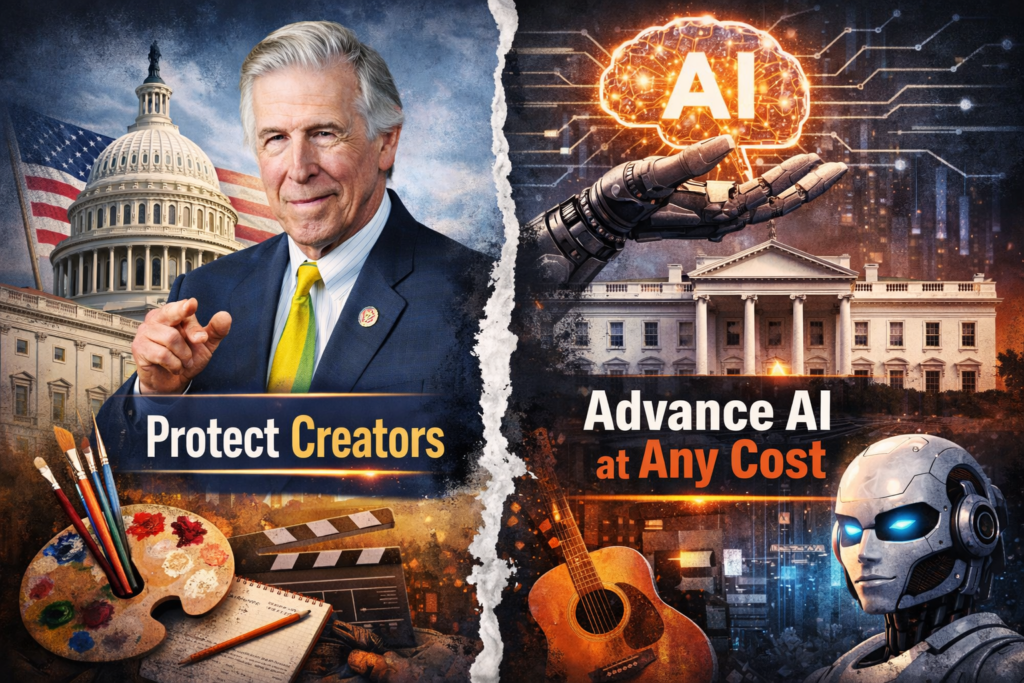
If America Stops Protecting Its Creators, It Won’t Lose the AI Race — It Will Lose What Made It Worth Winning
“Every child is an artist. The problem is how to remain an artist once we grow up.” — Pablo Picasso
That line has stuck with me for years.
Because it cuts through all the noise—politics, technology, policy—and reminds us of something simple:
Everything starts with a creator.
A song.
A story.
A sketch.
An idea.
That is where innovation actually begins. Not in a boardroom. Not in a federal memo. Not in a Silicon Valley think tank. It begins with a person making something that did not exist before.
And right now, that question—who creates, who owns, and who profits—is at the center of a growing fight over artificial intelligence.
Falls Church Congressman Steps In
U.S. Rep. Don Beyer—the Falls Church Congressman representing Virginia’s 8th District—has stepped directly into that fight with a bipartisan proposal called the AI Foundation Model Transparency Act. Introduced with Rep. Mike Lawler of New York and Rep. Sara Jacobs of California, the bill would establish transparency requirements for high-impact AI foundation models and direct the FTC, in consultation with NIST, the Commerce Secretary, and OSTP, to determine what information these companies must disclose to regulators and to the public.
That matters because right now many of the most powerful AI systems in the world operate as black boxes. They are trained on enormous pools of books, journalism, art, music, code, archived writing, images, and other human-created material, yet the public generally has no meaningful way to know what went in, how the models were trained and tested, or whether user data is being collected during use. Beyer said users deserve to know “how a model was built and what background information it bases its results on,” while Lawler called transparency the
That is not some fringe idea. It is common sense. If these systems are increasingly used in areas that touch real lives—housing, lending, health information, government decisions, law enforcement—then the public should have the right to know what is inside the machine before the machine starts making or influencing life-changing judgments. That is the power of Beyer’s bill. It does not pretend transparency solves everything, but it starts where any serious regulatory system should start: show your work.
And Then There’s the White House Plan
Now set that next to the Trump administration’s newly released National Policy Framework for Artificial Intelligence Legislative Recommendations. The White House document presents itself as a roadmap for American leadership in AI. It calls for faster infrastructure buildout, streamlined permitting, reliance on existing regulators rather than a new AI rulemaking body, and broad federal preemption of state AI laws deemed too burdensome. It also takes the administration’s view that training AI models on copyrighted material does not violate copyright law and urges Congress not to interfere with the courts’ fair-use analysis.
That is where the problem begins.
Beyer’s bill says: show the public what these systems are built on.
The White House framework says, in effect: keep moving, keep building, and let the hardest questions sort themselves out later.
One is specific. The other is broad. One tries to close loopholes. The other leaves some of the biggest loopholes wide open.
The Difference Is the Story
That contrast is not some technical dispute for policy specialists. It is the story.
Because once you strip away the branding language—innovation, leadership, competitiveness, dominance—you are left with a very basic question: who benefits when the rules are vague?
It is not the independent artist. It is not the songwriter. It is not the local journalist. It is not the small startup still trying to break in. It is the company that already has scale, already has compute, already has the lawyers, already has the datasets, already has the market reach, and can afford to keep moving while everyone else waits for the law to catch up.
That is why this matters so much. Ambiguity is not neutral. In Washington, ambiguity is often a form of power. It allows the biggest players to move first, profit first, and answer later.
We’ve Seen This Before
If you have followed my writing for any length of time, you know I have been sounding this alarm for years. In my “Titans of America” series, I argued that the internet most Americans think they are using—a free, open, competitive digital commons—is, in reality, increasingly controlled by a handful of corporations that do not merely participate in the system but function as the system itself.
Google. Meta. Amazon. Apple. Microsoft.
These firms do not just host content, distribute it, monetize it, rank it, moderate it, and study it. Increasingly, they also sit at the gates of who gets seen, who gets paid, who gets heard, and now, through AI, who gets absorbed.
So when Washington announces a policy framework designed to “remove barriers” and “unleash innovation,” the honest question is: innovation for whom?
Because when rules are broad and penalties are unclear, the advantage goes not to the dreamer with the next big idea, but to the platform already large enough to turn everybody else’s work into fuel.
Let’s Be Real
There is no AI without content.
And there is no content without creators.
There is no The Lion King without artists, animators, composers, writers, editors, performers, and designers. There is no Barbie. No Everything Everywhere All at Once. No breakthrough film, no chart-topping album, no unforgettable character, no line of dialogue people carry with them for years, unless somebody sat down and created it first.
And yes, sometimes that art sparks backlash. Sometimes movies become culture-war flashpoints. Sometimes musicians anger politicians. Sometimes artists are attacked precisely because their work has power. But that is not a flaw in a free society. That is evidence of one. Art that moves no one, offends no one, challenges no one, and inspires no one is not the backbone of a living culture.
That is why the contradiction in this moment is so glaring. The same political forces that often rail against Hollywood, pop culture, museums, and elite storytelling for being too influential, too ideological, or too corrosive are now backing a framework that could make the largest AI companies even more powerful by allowing them to ingest, mimic, and monetize the very creative ecosystem they claim to distrust.
This Isn’t Just Culture — It’s the Economy
And this is where the lazy argument collapses. The people who dismiss art, culture, writing, music, and storytelling as somehow secondary to the “real” economy do not know what they are talking about.
According to the U.S. Bureau of Economic Analysis, arts and cultural production accounted for 4.2% of U.S. GDP in 2023, or $1.17 trillion. Real arts and cultural economic activity increased 6.6% in 2023, compared with 2.9% for the broader economy. In other words, culture was not lagging the American economy. It was outgrowing it. :
The U.S. Patent and Trademark Office says IP-intensive industries accounted for $7.8 trillion in GDP in 2019, or 41% of total U.S. GDP. The broader USPTO report also found that IP-intensive industries supported roughly 63 million jobs, about 44% of all U.S. employment. :
And the National Science Foundation says the U.S. research and development enterprise reached roughly $940 billion in 2023. That is the scale of America’s national investment in discovery, invention, and original value creation.
Put that together and the picture is obvious. America does not dominate because it copies. America dominates because it creates. People make things. The law protects what they make. Capital forms around it. Industries grow from it. Jobs depend on it. GDP rises because of it.
That is the American formula.
And if Washington now leaves loopholes that allow the biggest AI systems in the world to consume the work of writers, artists, musicians, filmmakers, photographers, coders, and journalists without clear transparency, clear consent, or clear compensation, that is not modernization. It is the hollowing out of the very ecosystem that makes American growth possible.
The Loophole That Changes Everything
Go back again to the White House framework. Its position that training on copyrighted material does not violate copyright law, combined with its reluctance to press Congress into defining hard rules, is not some side issue. It is the whole game.
Because that means the burden falls not on the giant companies doing the ingesting, but on the creators trying to figure out whether their work has already been used, copied, modeled, or transformed inside systems they cannot inspect.
That is exactly why Beyer’s bill matters so much. It is not perfect, and it is not the final word, but it at least recognizes the central truth the White House framework is too willing to glide past: people cannot protect what they cannot see. If artists and authors do not even know whether their work is in the training corpus, how are they supposed to exercise rights? If the public does not know how the system was trained, how is the public supposed to trust it?
Right now, creators are effectively being told: wait. Wait for lawsuits. Wait for courts. Wait while the systems built on your work grow larger, more profitable, and harder to unwind.
That is not innovation. That is extraction.
The Cultural Contradiction
The contradiction gets sharper when you look at the administration’s broader cultural posture. In March 2025, the White House issued Restoring Truth and Sanity to American History, arguing that the Smithsonian had been influenced by a “divisive, race-centered ideology” and that these narratives portray American and Western values as inherently harmful.
Fine. Have that argument. People in a free country are allowed to battle over culture, values, history, and meaning.
But then be honest about what follows from that argument.
If art and culture are powerful enough to shape minds, shape society, and shape the national story, then they are powerful enough to deserve protection from mass, opaque extraction. You cannot scream from the rooftops that culture matters and then shrug while giant AI systems vacuum up culture as raw material. You cannot denounce the power of storytelling one day and treat storytelling as free industrial feedstock the next.
Where This Leads
The White House framework also leans into ideas like age assurance, parental controls, centralized national standards, and federal leverage over platform practices. Some of that may sound reasonable in isolation. But step back and look at the architecture.
Age verification tends to produce identity systems. Identity systems produce tracking. Tracking produces control. Control, once embedded in digital systems, rarely shrinks on its own.
That is where the Orwellian concern creeps in—not because everything in the framework is sinister, but because the logic of the system points in one direction: more monitoring, more centralization, more mediation between individuals and the information tools they use.
Put that together with a copyright posture that favors large-scale ingestion, and the shape of the future comes into view: a world in which dominant platforms can absorb human creativity at scale while governments increasingly shape the conditions of access around them.
The Line We Cannot Cross
America has always argued about culture. That is not new.
What is new is the scale.
What is new is the technology.
What is new is the possibility that, for the first time, the incentives that once protected creators could be so badly weakened that original work itself becomes merely a disposable input into somebody else’s machine.
No creators means no content.
No content means no innovation.
No innovation means no growth.
That is not a slogan. It is the chain.
Break it, and everything downstream suffers.
The Bottom Line
This is not really just about AI.
It is about America.
It is about whether the future belongs to the dreamers who make things, or the systems that absorb them.
Beyer’s bill says, at a minimum: show the public what you are building.
The White House framework says: trust the system, keep moving, and let the hardest questions settle later.
Those are two very different visions.
One begins with accountability.
The other begins with permission.
And the outcome will decide more than just the future of artificial intelligence. It will help decide whether the next generation of creators still has a place in the American story at all.
If America stops protecting its creators, it won’t lose the AI race — it will lose what made it worth winning.