

Early Voting for Special Election Starts Friday
Virginia voters will head to the polls starting this Friday, March 6, to weigh in on a plan to redraw the state’s congressional map in response to GOP gerrymanders in other states.
Yesterday, the Virginia Supreme Court ruled that the referendum election will proceed, staying the circuit court’s injunction that had temporarily blocked it.
The Supreme Court did not decide whether the amendment process was constitutional, according to a report by pro-Democratic Party attorney Mark Elias. “Instead, it relied on a long-standing principle in Virginia law: Courts generally do not use injunctions to stop elections before they happen,” he wrote. “The reasoning goes back over a century — elections are considered a political process, and courts typically review their legality after the voters have acted, not before.
The state supreme court cited precedent explaining that even if an election may ultimately be invalid, the judiciary should not prevent people from going to the polls. If the amendment is later adopted, courts can then determine whether the process complied with the Constitution and whether the result is valid.
“Importantly, the Court emphasized that the underlying constitutional challenges are still very serious and remain pending. The stay only means the election will occur — not that the legal arguments against the process have been rejected,” Elias wrote yesterday..
So, any registered voter will be able to cast an early ballot for the April statewide referendum that would allow for a U.S. congressional redistricting in time for this November’s critical midterm elections. The culminating election day will be April 21.
The ballot measure is in the form of an amendment to the Virginia constitution. The ballot question reads, “Question: Should the Constitution of Virginia be amended to allow the General Assembly to temporarily adopt new congressional districts to restore fairness in the upcoming elections, while ensuring Virginia’s standard redistricting process resumes for all future redistricting after the 2030 census? Vote Yes or No.
In Falls Church, early voting is done during normal business hours at the Voter Registrar’s Office at City Hall, 300 Park Avenue. Falls Church’s voter registrar David Bjerke confirmed to the News-Press that his office will be open beginning at 8 a.m. this Friday for any registered voter who wishes to cast a ballot in that election. He added that his office has already mailed out over 1,000 ballots to residents who signed up to receive mail-in ballots.
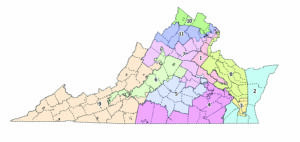
If the Yes votes win this upcoming election, new maps developed by the Democratic majority in Richmond could give Democrats the majority based on past voting patterns in 10 of the 11 U.S. congressional seats in the state.
That could mean that Democrats will pick up four more seats in the U.S. House of Representatives from Virginia than they currently hold.
That would help counter Trump’s unprecedented mid-decade gerrymanders in GOP-controlled states, including Texas, North Carolina and Missouri. Florida Republicans are also set to begin their own redistricting special legislative session in April.
If approved by voters, the new redistricting map would move the City of Falls Church into a newly configured 7th District that is currently represented by no one. U.S. Rep. Don Beyer, the Falls Church native who has represented the Little City since being elected to Congress a decade ago will no longer represent Falls Church, as the boundaries of his 8th District would be shifted eastward into central Arlington.
Advocates for a Yes vote on the ballot measure that goes to voters beginning this Friday emphasize that it is a temporary, but imminently necessary measure. If passed, it would result in heavily gerrymandered districts to counter Trump moves elsewhere, but could be undone once that threat passes in time for the normal redistricting process that takes place every decade following a national census.
Meanwhile this week, the U.S. Supreme Court (SCOTUS) declined to hear two petitions Monday brought by a leading advocacy group for more restrictive voting rules, which had asked the nation’s highest court to weaken a key federal voting law.
In one petition, related to access to the state voter rolls of Michigan, the Public Interest Legal Foundation (PILF) asked SCOTUS to reinterpret aspects of the National Voter Registration Act (NVRA) designed to expand voting access as, instead, a mandate for aggressive voter purges.
The NVRA, also known as the “Motor Voter” law which passed in 1993, is one of the most significant voting rights laws passed since the Voting Rights Rights Act was enacted in 1965. Among several other provisions, it requires states to make “reasonable” efforts to maintain accurate voter rolls.
But PILF has long sought to firm up the definition of “reasonable” in the NVRA’s language, and argued to SCOTUS that “reasonable” demands far more aggressive removals than states already do.