


An update on its fiscal performance during the last two months of 2025 finds the City of Falls Church ahead in most revenue categories despite the turbulence in the regional economy, Falls Church City Manager Wyatt Shields reported to the F.C. Council Monday night.
The Falls Church numbers are, relatively speaking, markedly better than those for its two much larger neighbors, Fairfax and Arlington counties, as well, he pointed out.
But declines in investment income and added costs the City will be asked to bear from its regional contracts, including with WMATA, the regional transit authority, could devour that relative advance and leave the City short going into the next fiscal year.
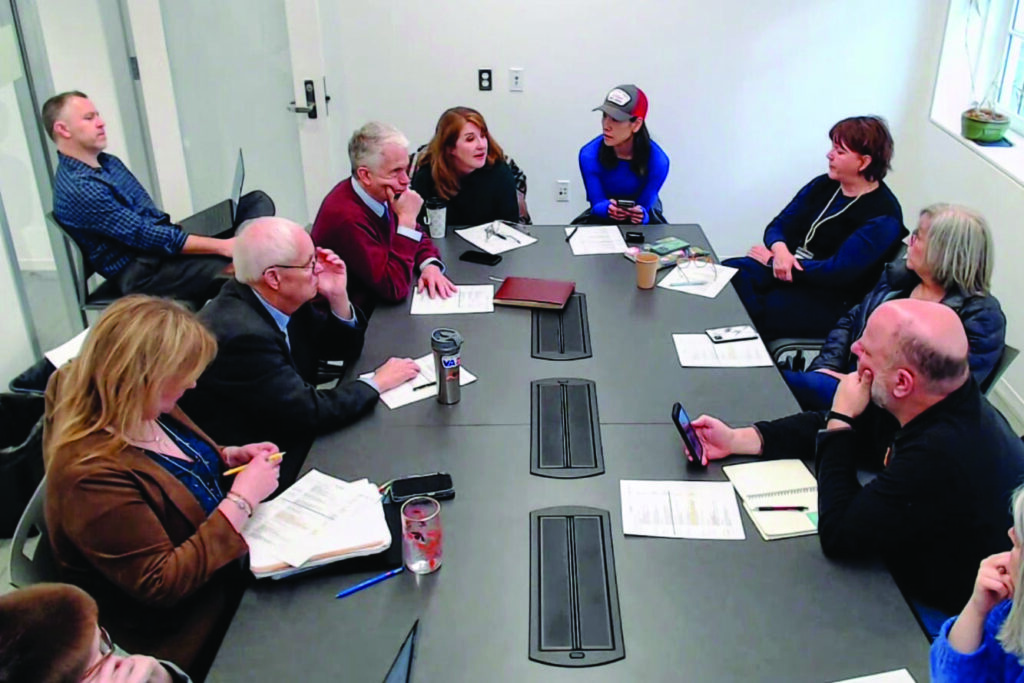
At a meeting of the F.C. Council’s budget and finance committee meeting last Friday, where this new data was first presented, the spectre of a very small tax rate increase was raised by one City Council member, although that prospect was not mentioned at the Council’s Monday regular business meeting.
Shields will present a recommended Fiscal Year 2027 budget to the Council in a month and the Council will have until May to adopt the new budget going into that fiscal year that begins on July 1.
A lot has to be added to the mix between now and a month from now, including the annual assessments of real estate in the City and the actual size of all the bills the City will be getting from its necessary regional entanglements, expected, minus WMATA, to be in the range of $1.3 million.
In a normal year, the annual real estate assessments would be done by mid-February, but this year there is a delay due to the fact that the City’s assessor, Erwving Bailey, left his job last fall to return to an earlier post he’d held in Arlington, leaving the Little City having to contract out on a one-time basis for its annual assessing. There was simply not enough time to arrange for a new assessor to be hired in time for this year, a process that is now delayed until after this budget season.
Still, assessments are expected to be in the range of a 3 to 3.3 percent overall increase, based on what Arlington and Fairfax are reporting to be theirs.
According to the report of F.C.’s director of finance David So, Falls Church’s general fund performance the last six months showed a 2.9 percent increase over budget, or $1.5 million, for the first half of the last fiscal year, such that, according to Shields, a $1.7 million surplus can be expected by the end of this fiscal year in June.
However, he noted that on the down side, an $800 million down payment on a move to develop the second phase of the West End project from the Hoffman Company will not be forthcoming, as the company has said it is not now in a position to proceed with that project expected to yield another $10 million to the City.
In addition, Shields said there is a $400,000 charge coming from Fairfax County for homeless services it had failed to bill the City for earlier, on top of $300,000 in costs for the snow removal from mid-February’s extraordinary storm.
Any surplus will also be subjected to the 50-50 revenue sharing agreement with the City schools, as well as the City’s commitment to its street paving efforts and affordable housing fund commitments.
So, Shields told the Council, “This is going to be an intense budget cycle.”
In other developments at Monday’s meeting,
The Council went into a late-night closed session with Dana Jones, the City’s Housing and Human Services Director, to discuss financial options for extending the list of affordable dwelling units (ADUs) in Falls Church. With 336 officially affordable dwelling units in the City now, including 130 that have been added with the last decade’s booming commercial development with no time limit on their designation, there are 63 older units whose affordable designation is due to expire between now and 2036.
In the closed session, it can be inferred that talk about the cost of changing the status of the soon-to-be-expired units to permanent, of “expiring ADU extension costs,” was undoubtedly discussed, along with the prioritization, or not, of the City’s acquisition of four-plex units at the so-called Virginia Village on S. Maple St.
Also, Monday’s meeting opened with a proclamation declaring the month of March 2026 as Women’s History Month. It cited the role of women in national and local leadership (it was noted the City’s mayor and vice-mayor, and its School Board’s chair and vice chair are all women) and announced the annual Women’s History Walk will take place May 9, honoring the contributions of City’s residents Marty Behr, Sharon Schoeller, Sandy Taerpinian and Melissa Teates.