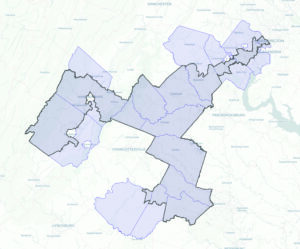


Apologies to our readers for publishing the incorrect information provided to us in last week’s paper that long-time Falls Church “favorite son” U.S. Rep. Don Beyer would continue to represent the City of Falls Church in the new congressional redistricting plan that will now be on a statewide ballot on April 21.
We chalk it up to the considerable confusion that attended the release of the proposed new maps last week. But now, with the help of the dauntless Virginia Political Action Project (VPAP), we can confirm that the Little City will be in a newly-carved 7th District (not Beyer’s 8th, now slightly to F.C.’s east) that currently has no incumbent congressman. The current U.S. Rep for the 7th, Eugene Vindman, has said he would be running instead in the 1st.
Two Democrats have announced so far. Arlington-based J.P. Cooney, who has served as a special counsel to federal prosecutor Jack Smith’s top deputy, announced last week. State Del. Dan Helmer of the 10th State District that runs from Centreville to Burke in Fairfax County, announced yesterday. Given the odd and long shape of the proposed district, voters can be assured that an abundance of candidates will likely apply for the job as if the new U.S Congress map referendum passes in April.
With the district drawn to favor the Democrats (in last November’s gubernatorial election, Democrat Abigail Spanberger carried it with 58.4 percent of the vote compared to 41.6 percent for Republican Winsome Earle-Sears), a primary that would be scheduled for the early fall in advance of this November’s midterm elections promises to offer an abundant number of choices.
But with 55 percent of the district population in its northernmost area of North Arlington, East Fairfax County and the City of Falls Church, it is most likely a candidate from this region, such as the two who’ve already announced, would be favored to win,
With state legislators currently in the heat of the Richmond session, it is unlikely any will tip their hand before that effort is resolved, if indeed they will not wait until after the April 21 referendum altogether. Falls Church leaders expressed hope this week someone with an intimate knowledge of their city will throw his or her hat in the ring, even as the City itself with its 11,049 citizens of voting age, is only 1.80 percent of the entire lobster-shaped district.
The proposed 7th District incompasses an astonishing 16 independent jurisdictions, with its part of Fairfax County having the largest share of its voting age population at 34.2 percent, followed by its part of Arlington County at 19.6 percent and then, as the district map extends to the south and west, it includes (in order of populations of eligible voters) part of Rockingham County, Culpepper County, Louisa County, Orange County, Powhatan County, part of Augusta County, Goochland County, part of Fauquier County, part of Prince William County, Greene County, the City of Falls Church, Madison County, part of Cumberland County and part of Buckingham County.
Last Friday, the Supreme Court of Virginia agreed to allow Democratic lawmakers’ mid-decade redistricting attempt to move forward, announcing it will hear the case on an expedited basis. The court denied Republican lawmakers’ motion to pause a redistricting referendum as the high court deliberates the case.
The order means voters will be able to approve or reject the redistricting amendment in a referendum scheduled for April 21. The effort would redraw Virginia’s congressional maps, with 10 districts favoring Democrats and one tipped towards Republicans.
According to the Virginia Department of Elections, the wording of the measure on the ballot will be: “Question: Should the Constitution of Virginia be amended to allow the General Assembly to temporarily adopt new congressional districts to restore fairness in the upcoming elections, while ensuring Virginia’s standard redistricting process resumes for all future redistricting after the 2030 census?”
Almost immediately after the Supreme Court order was released last Friday, Democratic leaders began to emphasize that the decision to redistrict or not will be in the hands of Virginians this spring.
“It’s a question of whether people want to move forward that’s responsive to the redistricting that we’ve seen in other states,” newly inaugurated Gov. Abigail Spanberger said. “Certainly the General Assembly was clear with the amendment process they put forward, and now it’s up to voters.”
Virginia House Speaker Don Scott, D-Portsmouth, also echoed the sentiment. Virginia’s redistricting effort is a response to President Donald Trump kicking off redistricting squabbles nationally by encouraging GOP-led states to fortify their party by redrawing their Congressional maps, Scott said.
“We have a president that’s run amok,” Scott said to the press last Friday morning. “So we have no choice but to respond and try to do everything in our power to level the playing field.”
While Virginia’s redistricting amendment surfaced in recent months, the national debates first began late last summer when Trump prompted Texas to redraw its maps. Other GOP states began following suit and pro-Democratic states like California, New York and Maryland began their own processes.
In advertising that began airing immediately, the Virginians for Fair Elections launched a website to advocate for and elicit support for passage of the measure. “Free and fair elections are the cornerstone of our democracy, and right now, they’re under threat,” the site states.
It adds, “Across the country, Trump and MAGAs-controlled legislatures are taking unprecedented steps to redraw congressional maps, without voter approval, to rig upcoming elections. As states like Texas, Ohio, North Carolina, and soon Florida move forward, Virginians face the real risk of having our voices diminished in Washington. The amendment gives Virginians the power to act – before it’s too late.”