

The stars are shining brightly over and in Washington, D.C.
From opera star Maria Callas’s costumes to stars from Australia, Washington’s galleries have something for every taste, and they’re free to see!
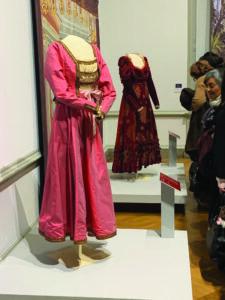
Six costumes worn by Maria Callas (1923-1977), one of the greatest opera singers of the 20th century, are shown for the first time in the U.S. at the Luther W. Brady Art Gallery, formerly the Corcoran Gallery near the White House.
They are gowns Callas wore in La Scala operas in Milan, dresses which range from a short dull mustard color in “La Sonnambula” in 1955 when she acted as a peasant, to a blue satin silk brocade floor length she wore in “Ifigenia in Tauride” in 1957.
In the same year, she wore a heavy dark blue velvet gown with a long fur-trimmed cape in “Anna Bolena” in a “lavish production” and one of Callas’s “greatest triumphs,” says Wikipedia.
Her last costume on display at the Brady was for her role as Fiorilla in the 1955 production of “Il Turco In Italia.”
Meanwhile, other “stars” shining in D.C. for the first time are over at the East Building of the National Gallery of Art in “The Stars We Do Not See,” the largest presentation of Australian aboriginal and Torres Strait Islander art ever presented in North America.
Almost 200 works by 130 artists from the National Gallery of Victoria in Melbourne, ranging from necklaces to huge canvases, photographs, video and neon which cover the late 1800s to present times are presented, many of the pieces traveling outside Australia for the first time.
Included is a video of Burarra women weaving traditional fish traps, bags, skirts and other items of natural materials
Myles Russell-Cook, Victoria’s former senior curator and current artistic director of the Australian Centre for Contemporary Art, curated the exhibition, writing on the Gallery’s website that Australia’s aboriginal artists can be traced back 65,000 years.
Australia has two distinct groups of Indigenous peoples: Aboriginals, who have roots in the mainland and Tasmania, and Torres Strait Islanders whose origination can be found on the islands off the northeast coast of Australia and the bottom of Papua New Guinea.
Before the British arrived in 1788, there were more than 600 Indigenous nations, representing more than 250 language groups and over 500 dialects.
Viewers will find some of the works similar to others in the exhibition with complicated crosses and dots, the crosses which represent visible stars in the sky and what is visible in the known universe, while the dots are the unknowns with everything connected, the knowns and unknowns. (Former U.S. Defense Secretary Donald Rumsfeld and his “knowns and unknowns” might have had an Australian connection.)
The National Gallery of Art offers several related events for the Australian show.
At the East Building Information Desk, one hour public tours will start at 1 p.m. on Jan. 31, Feb. 7, Feb. 13, Feb. 27. Reservations are not required.
On Feb. 8 at 2 p.m., “Still We Rise,” films by Indigenous Australians will be screened in the East Building Auditorium. Register on the website.
On Feb. 12 beginning at 6 p.m., the National Gallery returns its celebrated “Gallery Nights” featuring music and festivities about the Australian exhibition. Sign up for lottery tickets on the website.
On Feb. 28 in the East Building concourse, Cameron McCarthy, an Australian artist and performer, will play the didgeridoo at 2 p.m. and, again, at 4 p.m. to demonstrate its sounds which mimic Australian animals.
The National Gallery has many related items for sale in its gift shop, ranging from mugs to socks to jewelry to tote bags, from $5 up to $100, including a catalogue for $60 (hardback, 320 pages).
From Washington, the Australian exhibition will travel to museums in Denver, Portland, Oregon and Salem,Mass.
Included in the Callas exhibition are sketches of the gowns and rare photographs of Callas. Corcoran Theatre and Dance students researched and wrote the label copies for the exhibition; La Scala loaned the costumes.
Callas died at 53 of a heart attack, possibly caused by an extreme weight loss of 80 pounds when she was only 30. Some attribute her voice’s decline in her 30s to her weight loss and drugs. She retired from the stage at age 41.
“Callas at La Scala” is presented by the Italian Cultural Institute and the Embassy of Greece, in collaboration with La Scala Opera House and George Washington University which owns the former Corcoran building.
Callas ends Mar. 21, 2026 at the Brady Gallery, 500 17th St. NW, open Wednesday – Saturday, 1 – 5 p.m. (closed Feb. 14, 2026), and Australia ends Mar. 1, 2026 at the National Gallery of Art, 4th St. and Constitution Ave. NW, open every day, 10 a.m. – 5 p.m. Timed entry for either exhibition is not required.