


By David Hoffman
It begins with Latin verse written two millennia ago about the siren song in praise of the folly of war by the Roman poet Horace.
Verse almost as “ancient of days” as that from the Greek poet of the Trojan War — the tragic conflict inflicted as remorseless revenge over the virginal kidnapped Helen — Homer.
“Dulce et decorum est pro patria muri.”
Translated, “It is both sweet and proper to die for your country.” But is it? Really?
True, as the old saying goes, Rome certainly wasn’t built in a day. Try centuries. And it was built on the backs of wars and rumors of wars — e.g. the Punic Wars against doomed Carthage, with victorious Roman salt plowed into its soil
And this sentimental Roman claptrap, this rote pro-war jingoism, this cheap humbug, certainly not originate in Donald Trump’s Oval Office — as in his present-day foolish sabre rattling over seizing Greenland from the grave national security threat posed from our NATO partner, the dangerous Kingdom of Denmark.
Or his recent abrupt airborne illegal invasion of Venezuela, to kidnap its genuinely dictatorial and egregiously monstrous Maduro — and his wife., the warlike Latina Boadica. The Donroe Doctrine, to be sure. An act of war, without any doubt.
Exactly as if China were to stage a similar stunt by invading nearby Taiwan to arrest its president.
Or if Russia were to invade (Trump style) neighboring Ukraine. Oh wait, it already has. Vladimir Putin, aka “Vladolf Putler” with his Fuehrer namesake Adolf Hitler, invading innocent Poland in September 1939, as proclaimed in the famed poem by W.H. Auden.
Dulce et decorum est….. Blitzkreig. Pearl Harbor. Stalingrad. Dresden. The Holocaust. Hiroshima. Nagasaki ….. pro patria mori.
Echoes of our own General, during our own Civil War, William Tecumseh Sherman, after the torching of Atlanta on his march through Georgia to the sea, ending at Savannah: “War is Hell.” Indeed.
All now gone with the wind, the same sad wasteland ravaged by all wars, from the Athenian wars with its neighboring Sparta to the poet Shelley’s ancient King Ozymandias’ vain and silly claim of “Look on my works, ye mighty and despair!”
To our own day. Việt Nam. Iraq. Venezuela. Greenland?
Reminders even of the warlike 1st century CE British tribal queen Boadicea — since the Victorians, a cultural symbol of English “arms and the man,” who valiantly led a failed uprising against a conquering Roman army. Sic transit gloria mundi. Or in a latter-day tongue-in-cheek version, “Rule Britannia, Marmalade and Jam.”
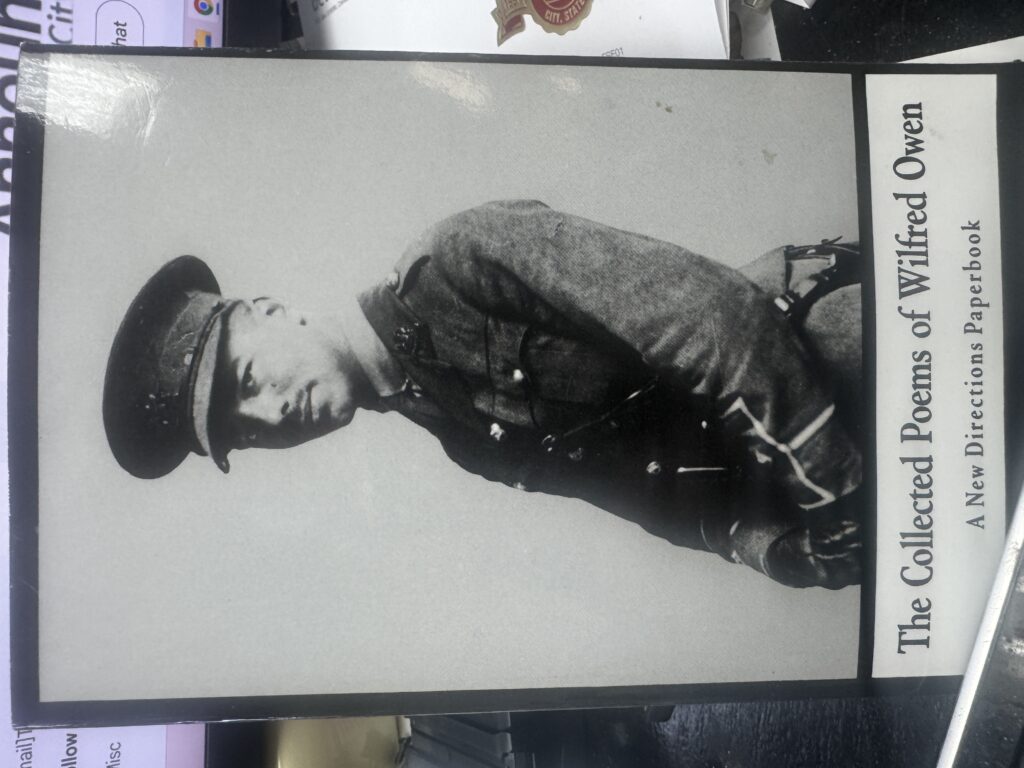
The best way to end is with another poem. The one written by the remarkable 25-year-old English lyric poet Wildred Owen, the bard of the antiwar generation of young men who died pointlessly at bayonet points and choking poison gas in the awful trenches of Flanders fields in 1916 and 1917. It includes the love affair between Wilfred Owen and another antiwar poet, Siegfreid Sassoon, who met Owen when he was being treated in hospital for shell shock, then called neurasthenia.
It was Owen who called “dulce et decorum est” the “old lie” fatuously told by the Roman poet Horace (born circa 65 BCE) that it was “sweet and fitting to die for one’s country.”
It was Owen whose poem graphically depicted the horrors of battle, who stripped away the self-serving illusions of “dulce et decorum.” (Even Horace, who served as a beardless youth in the Roman army, had to confess that he himself dropped his own shield and fled the battlefield.)
It was Lieutenant Owen, an evangelical Anglican who studied at the University of London, who died in battle on November 4, 1918. One short week before the Armistice.
It is believed that Owen was gay, though no one can actually be sure. But homoeroticism is a central element in his poetry. And Owen clearly loved Sassoon, who most emphatically was gay, and who lived until 1967, with many love affairs along his very gay way, and who would later write of Owen: “W.s death was an unhealed wound.”
“An ache of it has been with me ever since.”
David Hoffman is a longtime member, as well as former vice-president for programs, of the Woman’s National Democratic Club, in Washington DC, founded by suffragist women in 1922. Men have been members since the 1980s.